Creighton University | 2020
Evaluating Graduate School Website Usability Through Structured Testing
Overview
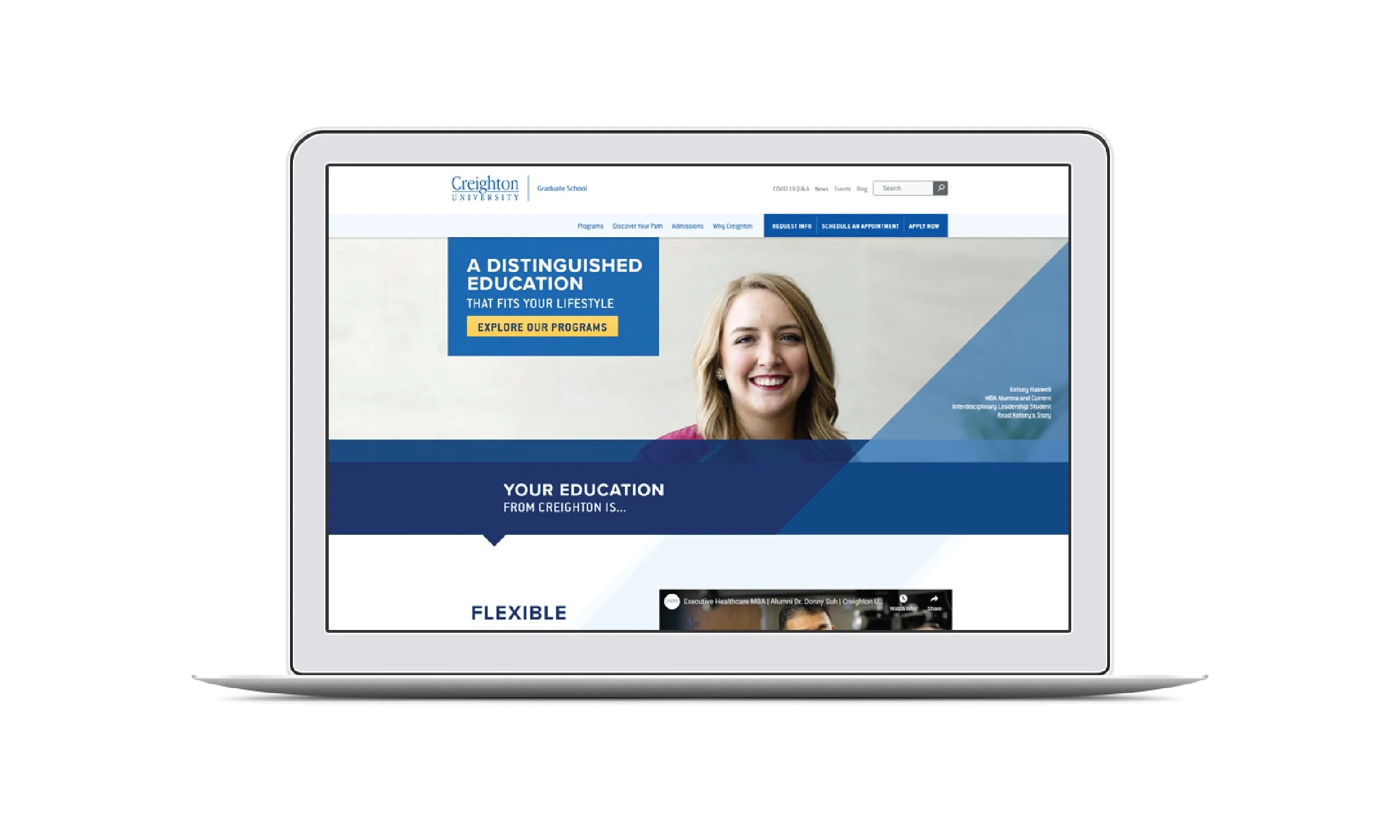
Led a structured usability testing initiative to evaluate the newly redesigned Graduate School website prior to broader rollout. The goal was to validate navigation clarity, task completion success, and overall usability while identifying potential friction points early in the launch lifecycle.
This project focused on establishing a scalable usability testing framework within a higher education digital environment.
The Challenge
Following a major website redesign, the Graduate School needed validation that prospective and internal users could:
Locate program information efficiently
Navigate key academic workflows
Understand content hierarchy and structure
Complete high-priority tasks without friction
The challenge extended beyond testing a single website — it required formalizing a repeatable usability testing process that could scale across future university initiatives.
Scope of Ownership
Designed and structured the usability testing plan
Developed facilitator and participant testing guides
Defined task scenarios aligned with core Graduate School workflows
Conducted moderated, in-person usability sessions
Trained internal web strategists to serve as facilitators
Established reusable research documentation framework
Research Methodology
A moderated, in-person usability testing approach was selected to capture both qualitative and quantitative insights.
Methods included:
Task-based usability sessions
Direct observation of participant behavior
Post-task survey questions to measure usability perception
Structured participant commentary and facilitator documentation
This approach allowed for real-time behavioral insight while capturing measurable usability indicators.
Testing Planning & Preparation
Significant preparation ensured consistency and reliability across sessions.
Preparation included:
Development of participant-facing usability testing guides
Creation of facilitator scripts to ensure structured moderation
Identification of task scenarios representing key Graduate School workflows
Selection of participant groups reflective of user audiences
Internal marketing strategists served as the initial testing group due to their familiarity with academic workflows and website content structure.
Undergraduate students were identified as a second critical participant group to represent prospective Graduate School users.
Faciltator Training & Enablement
To scale the initiative, I trained fellow web strategists to serve as usability testing facilitators.
Training included:
Observation of live moderated sessions
Guided facilitation practice using standardized scripts
Instruction on objective documentation of findings
Structured debrief discussions
This approach established a consistent moderation standard and expanded the university’s internal research capability.
Constraints & Interruption
Before student recruitment and broader testing could occur, the onset of COVID-19 resulted in campus closures and suspension of in-person research activities.
While the full study could not proceed as planned, foundational research infrastructure had already been established.
Outcomes & Impact
Despite interruption, the initiative delivered meaningful value:
Established a formal usability testing framework for the Graduate School
Created reusable participant and facilitator documentation
Conducted initial moderated sessions to surface early usability insights
Trained internal staff in structured usability research methods
Laid groundwork for future prospective student testing
This project strengthened the university’s research maturity and formalized usability testing as a repeatable, scalable process within the web strategy team.